
Key Components of an Ion Chromatography System Explained
When you work with ion chromatography, understanding each component’s role is essential for accurate analysis. From the pump that ensures steady flow to the injector that introduces your sample precisely Anion analysis, every part influences your results. The separation column and detector play critical roles in distinguishing and measuring ions, while software ties everything together for clear interpretation. But how exactly do these pieces fit to deliver reliable data?

What Is the Pump’s Role in Ion Chromatography?
The pump drives the entire ion chromatography process by delivering a consistent flow of the mobile phase through the system. You rely on it to maintain precise pressure and flow rates, ensuring your analysis stays accurate and reliable. Without the pump’s steady push https://laballiance.com.my/, the ions wouldn’t separate properly, and your results could become unpredictable.
The pump gives you control and consistency, so you’re free to focus on interpreting data instead of worrying about equipment fluctuations. It’s designed to handle high pressures and maintain stability over long runs, letting you work efficiently without constant adjustments. In short, the pump is your system’s heartbeat, powering the flow and making sure every sample moves smoothly through the column for dependable separation.
How the Injector Works in Ion Chromatography
Once the pump has set a steady flow, the injector steps in to introduce your sample into the mobile phase stream. You control this process, ensuring your sample enters the system precisely and cleanly. The injector uses a valve mechanism to switch between loading your sample and injecting it, minimizing any disruption to the flow. By doing this, it maintains the system’s stability and accuracy.
You’ll appreciate how it lets you inject tiny volumes without wasting material or compromising results. Whether you use manual or automated injectors, they give you freedom to handle various sample sizes and complexities effortlessly. In short, the injector acts as your gateway, smoothly transferring your sample into the chromatographic journey without interrupting the steady flow set by the pump.
Why the Separation Column Matters in Ion Chromatography
Understanding why the separation column matters in ion chromatography helps you appreciate how your sample’s ions get sorted and identified. This column acts like a gatekeeper, selectively interacting with ions based on their charge, size, and affinity. As your sample flows through, ions separate because they interact differently with the column’s stationary phase, allowing you to distinguish each component clearly.
Choosing the right column gives you control over resolution and speed, matching your freedom to explore diverse samples. If you want accurate, reliable results, the column’s chemistry and design must fit your specific analysis needs. Without a proper separation column, your ions would mix, making it impossible to identify or quantify them effectively. So, the column is essential—it’s where the magic of separation really happens.
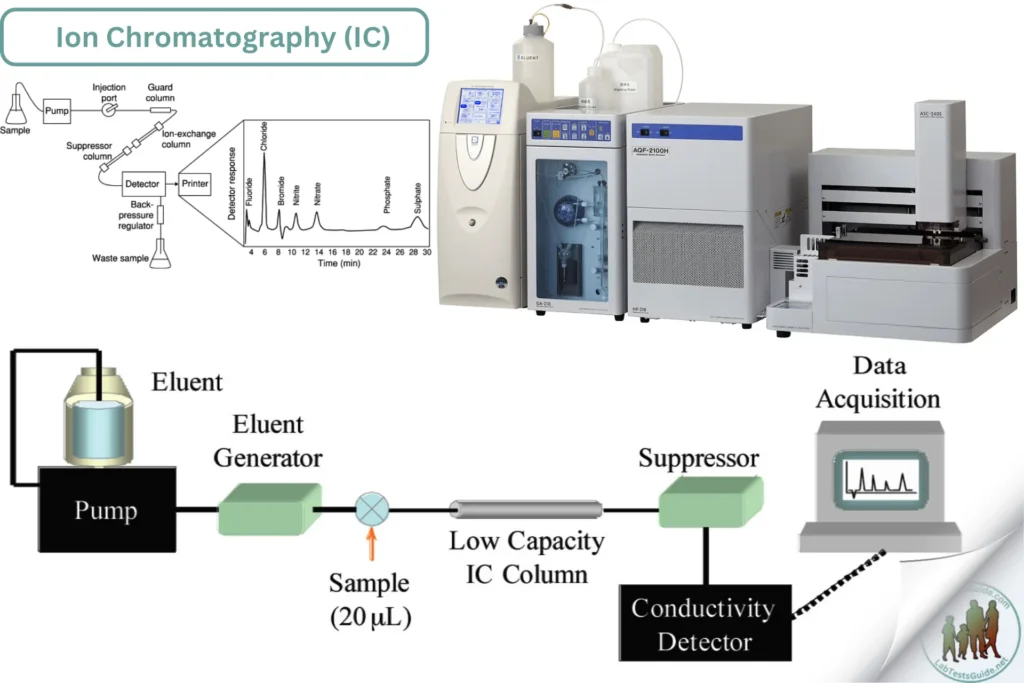
How the Detector Measures Ions in Ion Chromatography
Although the separation column sorts your sample’s ions, the detector plays a crucial role by measuring and identifying them as they exit the column.
You rely on the detector to translate those separated ions into meaningful signals. Here’s how it works:
- Conductivity Detection – The detector measures the electrical conductivity of the eluent. Since ions conduct electricity, their concentration directly affects the signal strength.
- Suppression – To boost sensitivity, a suppressor reduces background conductivity, making ion signals stand out clearly.
- Signal Conversion – The detector converts conductivity changes into electrical signals, which your system records for each ion.
Data Analysis and Reporting in Ion Chromatography
After the detector captures and converts ion signals, you need to analyze the data to identify and quantify the ions accurately. You’ll rely on software that processes chromatograms, highlighting peaks corresponding to different ions. By comparing these peaks to known standards, you can pinpoint ion types and concentrations quickly.
Don’t get bogged down by complicated reports; modern systems let you customize how results display, so you get just what you need. With clear data visualization and automated calculations, you’ll make informed decisions faster and with less hassle.
Once your analysis is complete, generating detailed reports becomes straightforward, helping you share your findings effortlessly. This freedom to control your data means you stay efficient, confident, and in charge of your ion chromatography workflow.
Conclusion
You’ve seen how each part of an ion chromatography system plays a vital role—from the pump’s steady flow to the injector’s precise sample delivery, the column’s selective separation, and the detector’s sensitive measurements. Together, they give you accurate, reliable results. With smart software analyzing data and generating reports, you can confidently identify and quantify ions in your samples. Understanding these components helps you optimize your work and get the best from your ion chromatography system.